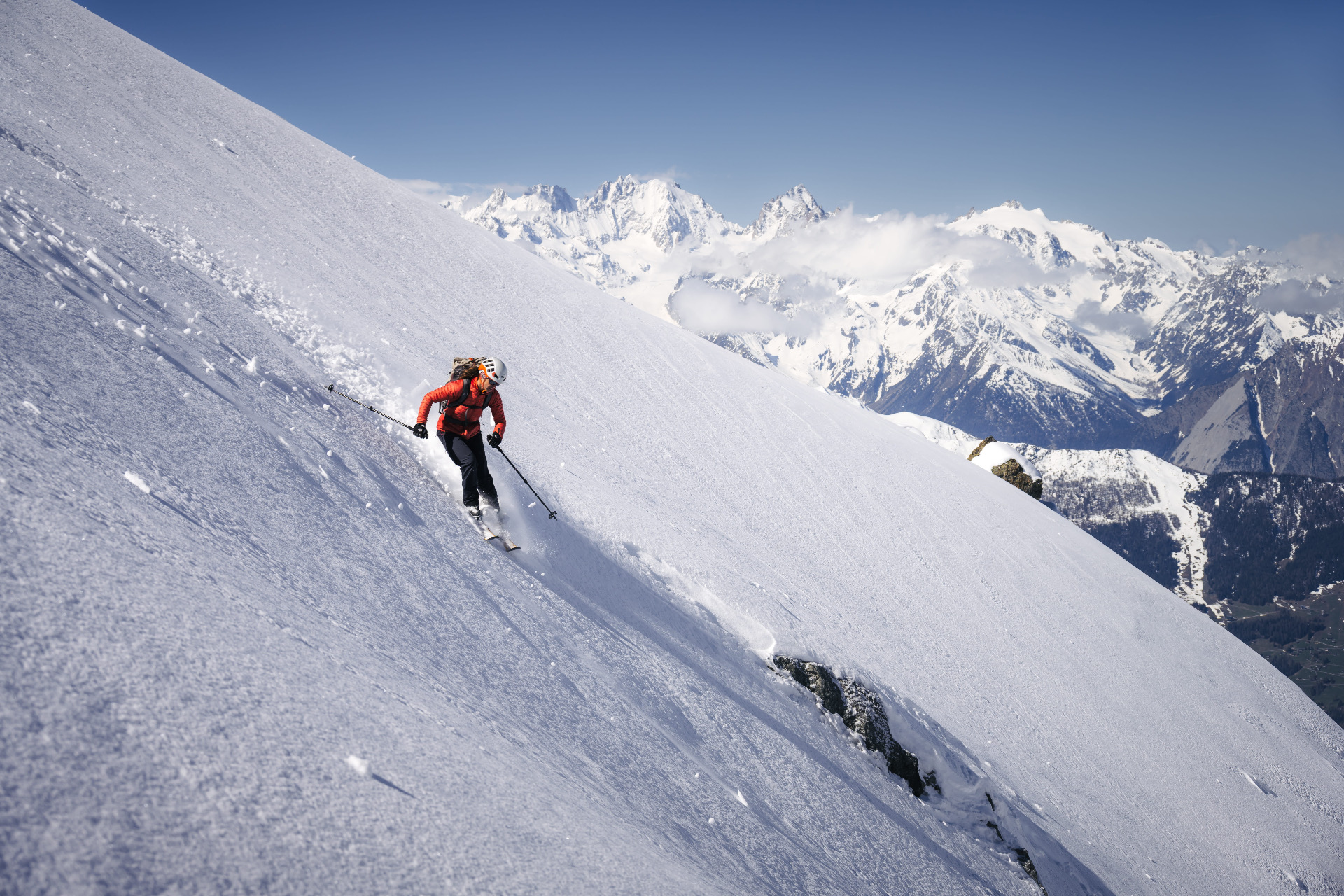
In Switzerland a mountain hut is called a cabane. Here is what that word means, how a private luxury mountain hut differs from a chalet in the village, and what a day at 3,000 metres is really like.
At 3,000 metres above Verbier, between the Tortin Glacier and the summit of Mont Fort, stands a building that people often struggle to name. It is not quite a chalet, and it is certainly not a hotel. In Switzerland the right word is cabane, and Cabane Tortin is a luxury mountain hut: the old idea of the Alpine refuge, kept intact in its setting and rethought in almost everything else. This article explains what a cabane is, how a private one differs from a chalet in the village, and what it is actually like to spend several nights at altitude.
What is a cabane? The Swiss mountain hut explained
In the French-speaking Alps, a cabane is a mountain hut: a building set high above the valley, usually far from any road, where climbers, ski tourers and walkers sleep, eat and wait out the weather. German speakers call it a Hütte, Italians a rifugio. Valais, the canton that holds Verbier and many of Switzerland's highest peaks, has a great many of them, a large number run by the Swiss Alpine Club.
The traditional cabane is defined by three things: altitude, simplicity and a guardian. You arrive on foot or on skis, you sleep in a shared dormitory, you eat what the guardian has cooked at a long communal table, and you leave early. Comfort is secondary. What you are really there for is position: being high on the mountain when everyone else is in the valley.
From Alpine Club hut to luxury mountain hut
A luxury mountain hut keeps the position and changes the terms. Cabane Tortin sits at 3,000 metres, directly below Mont Fort (3,330 m), the highest point of the 4 Vallées, beside the ancient Tortin Glacier. That is cabane territory in the classic sense. The difference lies in who is there and how they are looked after.
There are no dormitories and no shared bookings. The Cabane is booked for exclusive use only, for up to 10–12 guests, so the whole building belongs to one party for the length of the stay. In place of a single guardian there is a dedicated team: a gourmet private chef, a concierge, a mountain guide, service staff, guardians and housekeeping, whose quarters are fully separate on site.
The architecture, by the Norwegian architect Snorre Stinessen, is glass, timber and stone, with floor-to-ceiling windows that make the Mont Blanc massif, the French 4,000 m peaks and the Combins massif part of the interior. There are 420 m² inside: an open-plan great room with polished concrete floors, reclaimed-wood beams and a suspended fireplace; three king bedrooms on the main level, the master with a private bathroom and sunrise views towards Mont Blanc; and a lofted pod room above. On the same level there is a walnut-lined sauna, and outside a south-facing sun terrace with an open fire pit.
The building is also off-grid, running on solar power with wood-fired backup heating and water from a natural mountain spring, which is very much in the spirit of a refuge. In 2025 it was named World's Best New Ski Chalet at the World Ski Awards, and it is the highest private luxury cabane in the Alps.
Cabane, chalet or hotel: what actually changes
Anyone planning a ski holiday in Verbier ends up comparing three kinds of stay. A hotel gives you service and a village address, but you share both with other guests. A luxury chalet in the village gives you privacy and space, and you travel up to the slopes each morning. A private cabane reverses the geography: you live on the mountain, and the valley becomes the place you look down on.
That single difference shapes the whole stay.
- The mornings. Guests ski freshly groomed slopes before the public arrives in this sector, usually around 9:30. The day starts high on the mountain rather than at the bottom of a lift.
- The skiing. A private groomed piste runs about 100 m from the Cabane to the main Mont Fort / Gentianes piste, the way into more than 400 km of pistes across the 4 Vallées, Switzerland's largest interconnected ski domain.
- The evenings. After the lifts close, the mountain empties. There is sunset skiing, then night skiing on the private piste, groomed after hours by the Cabane's tracked Can-Am.
- The quiet. At night the brightest lights are the stars. Telescopes, star maps and hot toddies are part of the house.
What a cabane does not offer is the village at the door: no boutiques, no restaurants within a short walk. For most people who choose one, that is precisely the point.
A day in a luxury mountain hut, hour by hour
It helps to picture the rhythm of a day.
Breakfast comes with a view across to the Combins massif. Your mountain guide, dedicated to your party for the whole stay, looks at the conditions and suggests the plan: groomed runs on the Mont Fort side, a ski tour into quieter terrain, or an easier morning for anyone still finding their legs. The guide works with all abilities, from resort skiing to backcountry, and non-skiers are fully catered for.
By mid-morning the first tracks are done. Some guests carry on into the wider 4 Vallées; others come back to the terrace. Afternoon tea is served daily. Late in the day the light turns towards the French 4,000 m peaks, and Sunset Après on the terrace, around the fire pit and the outdoor snow bar, is an optional tradition.
Then the sauna, with a snow plunge steps away, and dinner. The cuisine is bespoke, planned weeks in advance with each party, with trusted regional producers: Valais lamb, Gruyère d'alpage, heirloom vegetables from Rhône Valley farms. About 90% of produce comes from within 100 km. A curated cellar pairs Swiss wines with the nightly courses, the dining table seats the whole party, and kid-friendly menus run in parallel when needed. You can read more about the days on the mountain on our experiences page.
Getting there, and what is included
The practical question people ask about any mountain hut is how to reach it. The journey begins with a meet and greet in Verbier village, followed by a guided escort up to the Cabane. It is accessible only via lift, snow vehicle (the Cabane's tracked Can-Am, about 10 minutes from the top lift station), ski or snowshoe. Confident skiers can ski down directly from the summit; others can snowshoe or ski from the mid-station in under 40 minutes. Your luggage is brought up for you. Geneva is about 1 hour 45 minutes by road to the base of the mountain, and Sion, for private flights, about 40 minutes.
For Winter 2026/27, exclusive use costs CHF 54,000 for 3 nights, rising to CHF 115,000 for 7 nights. The rate includes the private chef with breakfast, afternoon tea and dinner, food, house wines and drinks, the dedicated team and mountain guide, a champagne reception on arrival, evening turn-down, sauna experiences, first tracks before the lifts open, private night skiing and guided backcountry touring. Ski passes are not included, and extras such as lunch in the Cabane, ski equipment or a wellness therapist can be arranged on request. The full breakdown is on our pricing page.
Is a luxury mountain hut right for your group?
A private cabane suits a particular kind of party. Families and children are welcome. Friends marking a birthday or an anniversary come for the sense of having a mountain to themselves. Corporate and executive retreats are possible, and distance from the valley does much of the work of a retreat on its own. Those who would rather walk to dinner in the village each evening may be happier in a chalet below.
The winter season runs from mid-December to late April, with a minimum stay of 3 nights; a 7-night minimum may apply at Christmas, New Year and February half-term. For peak dates we recommend booking 6–12 months ahead.
If you are weighing a chalet in the village against a few nights above it, the simplest next step is to read about the Cabane itself and then talk to us. Tell us who is coming and how you would like the week to feel, and our team will reply personally. Send us an enquiry.
Questions and answers
What is a cabane in Switzerland?
A cabane is the French-Swiss word for a mountain hut: a building high above the valley, usually beyond the reach of roads, where climbers, ski tourers and walkers sleep and eat. Most are simple, with shared dormitories and communal meals. Cabane Tortin keeps the setting, at 3,000 metres below Mont Fort, but is booked for exclusive use by a single party with its own dedicated team.
How is a luxury mountain hut different from an Alpine Club hut?
A traditional hut is shared: you book a bed, sleep in a dormitory and eat what the guardian cooks. At Cabane Tortin the whole building is yours, for up to 10–12 guests, with three king bedrooms and a lofted pod room, a private chef, concierge, mountain guide and service staff, a walnut-lined sauna and a sun terrace with an open fire pit.
How do you get to Cabane Tortin?
Stays begin with a meet and greet in Verbier village and a guided escort up the mountain. The Cabane is reached only by lift, by its tracked Can-Am (about 10 minutes from the top lift station), on skis or on snowshoes. Others can snowshoe or ski from the mid-station in under 40 minutes. Your luggage is brought up for you.
What does a stay cost, and what is included?
For Winter 2026/27, exclusive use costs from CHF 54,000 for 3 nights to CHF 115,000 for 7 nights. The rate includes the private chef and daily breakfast, afternoon tea and dinner, food, house wines and drinks, the dedicated team and mountain guide, first tracks, private night skiing and guided backcountry touring. Ski passes are not included.
Is a stay at 3,000 metres suitable for non-skiers and families?
Yes. Families and children are welcome, and kid-friendly menus run in parallel when needed. The mountain guide works with all abilities, and non-skiers are fully catered for, with snowshoeing, the sauna and snow plunge, the terrace and astronomy evenings with telescopes and star maps. Extras such as husky sledding or a wellness therapist can be arranged on request.